

_500x500.jpg)
『Karman Vortex Flow Meter Manual: Setting Up Multivariable Sensors for Saturated High-Temperature Steam Loops』Related information(clamp on meter|electromagnetic meter|venturi meterrotameter|orifice meter|ultrasonic flow meter|mass flow meter|coriolis mass flow meter|coriolis flow meter|magnetic flow meter|magmeter flow meter|magflow flow meter|mag meter flow meter|electromagnetic flow meter|vortex flow meter|turbine flow meter|thermal mass flow meter|thermal flow meter|rotameter flow meter)
Karman Vortex Flow Meter Manual: Setting Up Multivariable Sensors for Saturated High-Temperature Steam Loops
Quick Answer: Set the meter to saturated steam mode, connect the internal pressure sensor and PT100 input, and the Karman vortex flow meter from Silver Instruments converts volume flow to mass flow in kg/h. You get pressure, temperature, and total flow on one 4-20 mA HART output. Send pipe size DN, steam pressure bar, temperature degrees Celsius, and normal kg/h to get a configured quote.
This guide covers site setup for saturated steam loops from DN15 to DN300. The goal is accurate mass flow without adding a separate flow computer. Because saturated steam density changes with pressure and temperature, a multivariable Karman vortex meter gives a better payback than a standard volumetric meter.
Why Saturated Steam Needs Multivariable Compensation
Saturated steam at 5 bar has a density near 2.67 kg/m3. At 10 bar the density is close to 5.16 kg/m3. A vortex meter without pressure compensation can show the same volume flow for two different mass flows. That is a large error in a heating process. A palm oil refinery in Malaysia saw a 12 percent steam totalizer error between two shifts because the header pressure moved from 7 bar to 9 bar overnight. After switching to a pressure compensated Silver Instruments Karman vortex meter the totalizer matched the boiler feed water record within 1.5 percent.
Sensor Installation on a Saturated Steam Loop
Install the meter body with 15D straight run upstream and 5D downstream. For a DN100 line that means 1500 mm upstream and 500 mm downstream. Use a flanged meter on a steam header above DN50. Wafer bodies work well for smaller lines from DN15 to DN40. Mount the pressure sensor before the meter body. Never mount it after the meter on a saturated steam line because the vortex shedding creates a small pressure drop and the reading will be low. Insert the PT100 probe in a thermowell. The thermowell tip should reach the center third of the pipe cross section.
On a horizontal steam line the meter should be upright. This keeps condensate away from the bluff body. We have seen this on many job sites in Vietnam and Thailand where a food processor or dye house runs steam at 8 bar and 175 degrees Celsius. A vertical upward flow is best for wet steam because any condensate falls back and the meter sees mostly dry steam.
Menu Settings for Multivariable Mode
Open the setup menu and select the fluid type as saturated steam. Do not select superheated steam by mistake. That mode expects independent pressure and temperature inputs and can cause a large offset. Select the pipe diameter in DN. Choose mass flow units as kg/h or t/h. Set the pressure sensor range to match your process. For a 10 bar steam header use a 0 to 16 bar gauge sensor. Set
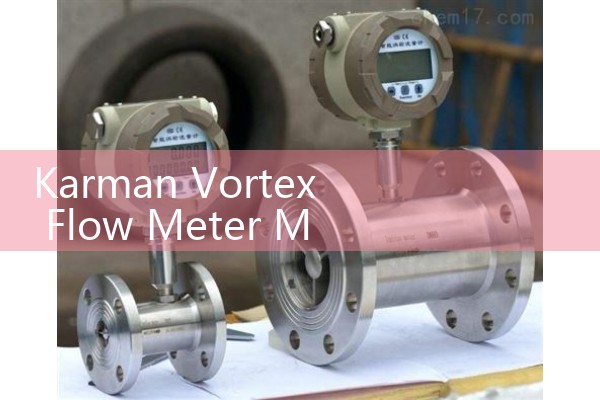
The Silver Instruments Karman vortex meter also supports pulse output for totalizing. The pulse value can be set per kg or per ton. If you use the RS485 Modbus RTU option you can read mass flow, volume flow, pressure, temperature, and total flow in one request.
Common Setup Mistakes on Saturated Steam Loops
One common mistake is using temperature only compensation on a loop with a pressure reducing valve. The pressure changes downstream but the temperature stays close to saturation. A temperature only reading cannot see the full density change. A pressure compensated meter is better for this job. Another mistake is placing the pressure sensor in a pocket of water. This can happen if the impulse line is not sloped back to the pipe. The reading becomes noisy and the mass flow value bumps around. In practice, keep the impulse line short and install a condensate pot if the steam temperature exceeds 200 degrees Celsius.
What to Send for a Configured Quotation
Send us the pipe size in DN, the steam pressure in bar, the steam temperature in degrees Celsius, and the normal flow range in kg/h. We will select the body size, pressure sensor range, PT100 insertion length, and output scaling. You can reach Silver Automation Instruments by phone at +86 25 68650347. WhatsApp is +86 25 52155837. WeChat is +86 15365082610. Website flow-meter.com.au
FAQ
Question: Can I measure saturated steam mass flow without a temperature sensor?
Answer: Yes. In a saturated loop the pressure and temperature are linked. A pressure sensor alone is often enough. Add a PT100 if you need temperature readout or energy calculation.
Question: What is the maximum steam temperature for a standard Karman vortex flow meter from Silver Instruments?
Answer: The standard meter handles up to 250 degrees Celsius. A high temperature version is available for up to 350 degrees Celsius.
Question: Does the multivariable meter need a separate flow computer?
Answer: No. The meter has built in steam tables and density compensation. It outputs mass flow directly on 4-20 mA HART or Modbus RTU.
Question: How do I set the pressure input range on the meter?
Answer: Enter the sensor span in the setup menu. For a 0 to 16 bar sensor enter 0 bar for the low value and 16 bar for the high value. The meter scales the 4-20 mA pressure input to this range.
Question: What pipe sizes are available for the saturated steam Karman vortex flow meter?
Answer: Standard sizes are DN15 to DN300. Larger sizes can be quoted on request. Wafer bodies cover DN15 to DN40 and flanged bodies cover DN50 to DN300.
 Hot Product
 Related AD