

『Coriolis force flowmeter』Related information(clamp on meter|electromagnetic meter|venturi meterrotameter|orifice meter|ultrasonic flow meter|mass flow meter|coriolis mass flow meter|coriolis flow meter|magnetic flow meter|magmeter flow meter|magflow flow meter|mag meter flow meter|electromagnetic flow meter|vortex flow meter|turbine flow meter|thermal mass flow meter|thermal flow meter|rotameter flow meter)

What are the installation requirements for Coriolis mass flow meters? The installation requirements for Coriolis mass flow meters mainly include the following points: Sensor installation direction: When measuring liquids, the main body of the horizontal pipeline should face downwards to ensure smooth liquid flow. When measuring the slag content of slurry or gas containing solids, the main body should face upwards to achieve self emptying. Installation pipeline requirements: Avoid using sensors on the Zhongju Qing pipeline and supporting pipelines. Ensure that the connecting flange matches and provide stable support on both sides of the sensor. The pipeline flange should be perpendicular to the pipeline. Special media considerations: For special media that are prone to crystallization, adhesion, etc., self emptying installation or the use of flushing devices should be considered. When measuring easily vaporized media, a distance of the same diameter should be maintained behind the sensor to avoid vaporization or cavitation. Pipeline levelness and support: The pipelines on both sides should be kept at the same horizontal plane with a deviation of no more than 0.5mm. Use stable supports to fix the pipeline flange and pipeline. Precautions for welding operations: During welding operations, the sensor should be removed. Ensure that the signal wires are disconnected and the power and signal connections are correct before the instrument is powered on for operation. Install additional facilities: Consider installing bypass or calibration ports for subsequent calibration and maintenance. Following the above installation requirements can ensure that the Coriolis mass flowmeter can work accurately and stably after installation,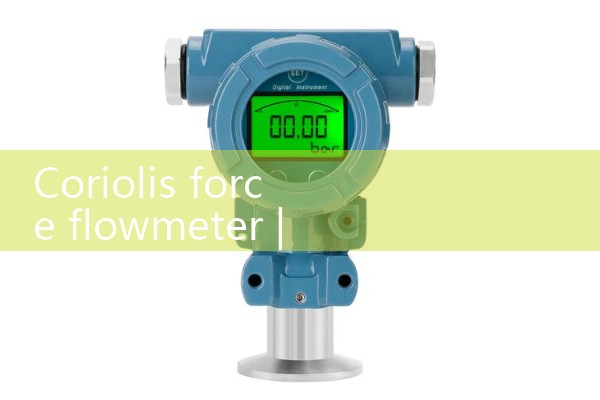
2. What are the three parts of a Coriolis mass flowmeter?
A Coriolis mass flowmeter consists of a sensor, a transmitter, and a display. Coriolis force mass flowmeter is a mass flowmeter that uses the modulation effect of fluid mass flow rate on the oscillation of a vibrating tube, namely the Coriolis force phenomenon, as the principle, for the purpose of mass flow measurement. It generally consists of a sensor and a transmitter. Rosemount mass flow rate calculation is based on Newtons second law: Coulomb force=mass x acceleration (F=ma). When a mass of m moves in a pipeline rotating at an angular velocity ω on the P axis at a velocity V, the mass is subjected to two components of acceleration and force. What are the installation requirements for Coriolis mass flow meters?
Coriolis mass flowmeter is an instrument that accurately measures gas flow rate. Its measurement results are not affected by temperature or pressure fluctuations, and do not require temperature and pressure compensation. It directly measures the mass flow rate of the medium, and can also measure the density of the medium and indirectly measure the temperature of the medium.. By using a microcontroller as the core, the Coriolis mass flowmeter has high flexibility and functionality, and is characterized by high cost-effectiveness, making it a representative of the new generation of flow meters. When selecting the installation method, it is necessary to choose the appropriate sensor installation direction based on the different measurement objects. For measuring liquids, the main body should face downwards when using a horizontal pipeline to ensure smooth p
 Hot Blog
 Related AD