

 Current position > News detail
『Heavy Crude Oil Flow Meter Reynolds Number Adjustments』Related information(clamp on meter|electromagnetic meter|venturi meterrotameter|orifice meter|ultrasonic flow meter|mass flow meter|coriolis mass flow meter|coriolis flow meter|magnetic flow meter|magmeter flow meter|magflow flow meter|mag meter flow meter|electromagnetic flow meter|vortex flow meter|turbine flow meter|thermal mass flow meter|thermal flow meter|rotameter flow meter)
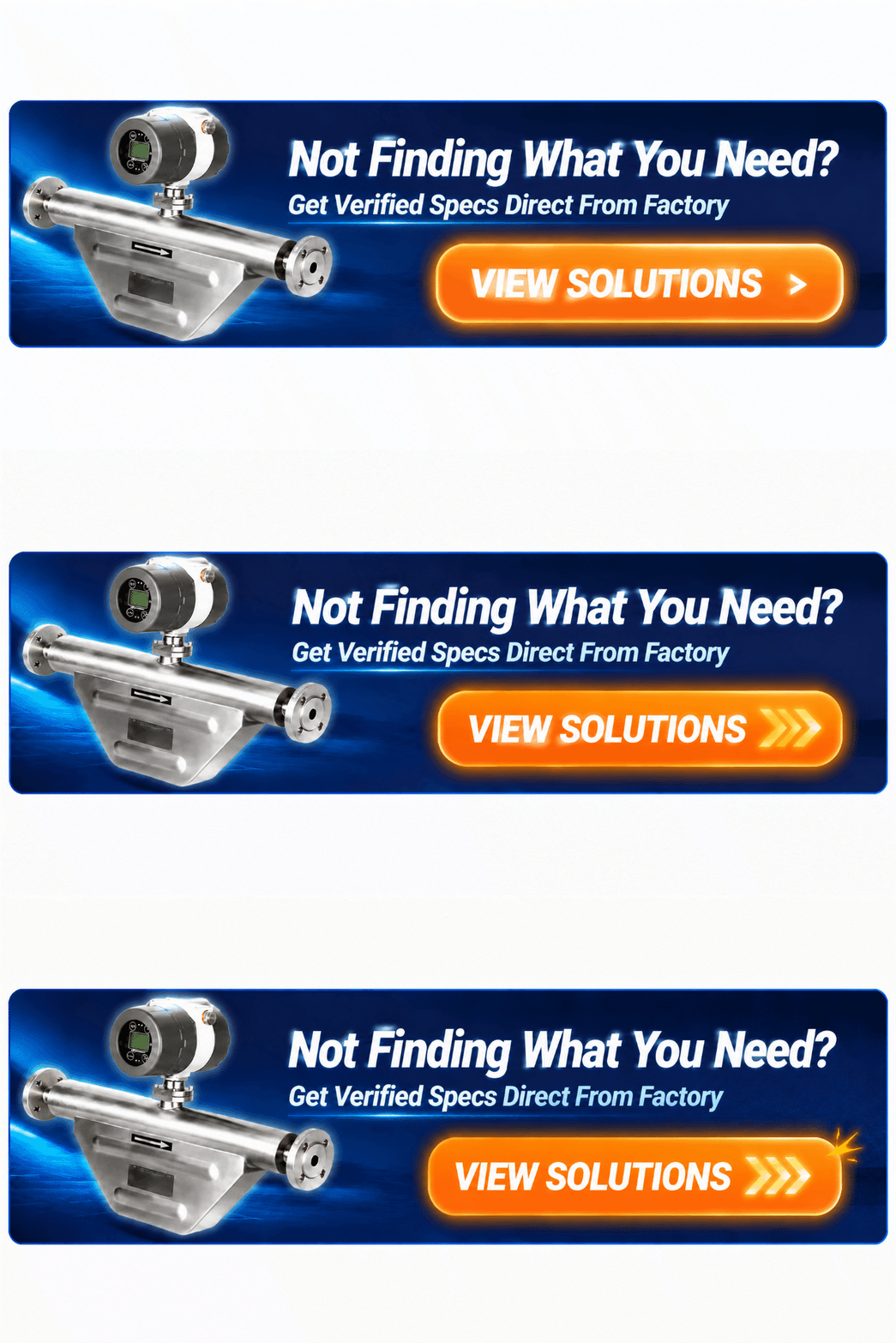
Heavy Crude Oil Flow Meter Reynolds Number Adjustments
Quick Answer: When you measure heavy crude oil at 10 to 18 API with a standard vortex or differential pressure meter, you often land in a low Reynolds number zone where the factory calibration curve loses linearity. Silver Automation Instruments recommends oval gear positive displacement meters or Coriolis mass flow meters for heavy oil. These two meter types do not rely on Reynolds number at all and deliver stable readings from 1 cP up to 5000 cP and beyond. If your budget only allows a vortex meter, you need a correction factor derived from a live viscosity measurement, and we can help with that sizing.
Why Heavy Crude Oil Breaks Standard Flow Meter Curves
Most velocity based flow meters assume a fully developed turbulent flow profile. Heavy crude at 80 °C to 120 °C in a DN50 or DN80 pipe often has a viscosity of 800 cP to 3000 cP. The flow velocity is kept low to avoid wax deposition or high pump loads. This combination pushes the Reynolds number down to 400, 800, or maybe 1200. A vortex flow meter from any manufacturer starts to lose its linear K factor below a Reynolds number of 5000. A DP flow meter with an orifice plate sees its discharge coefficient drift when the Reynolds number drops below 4000. In practice, a meter showing 5000 barrels per day could be off by 12 percent or 15 percent. Most engineers skip this part until the mass balance does not close at the week ending report. We have seen this on customer sites many times across the Middle East and Latin America.
Quick Reynolds Number Check for Your Oil Line
Here is a field example that is not from a textbook. A refinery in Oman runs heavy crude with a density of 960 kg/m3 and a dynamic viscosity of 1800 cP through a DN80 schedule 40 pipe. The flow rate is 8000 kg/h. The calculated velocity is around 0.46 m per second. The Reynolds number works out to about 390. That number is far below what any vortex meter wants to see. The inline meter was reading low by 14 percent compared to the tank strapping total. Because the Reynolds number was low, the bluff body shed vortices irregularly. The meter transmitter output a 4-20 mA signal that looked steady but the underlying pulse count was choppy. When the operator increased the crude preheating to 105 °C the viscosity dropped to 600 cP and the Reynolds number climbed to 1170. The vortex meter error shrank to 3 percent. But many heavy crude lines cannot run hotter due to overhead constraints or light ends loss.
Correction Methods When You Stick with a Vortex Meter
If you must apply a Reynolds number adjustment to a vortex flow meter, the typical path is to add a multivariable transmitter that pulls live pressure, temperature, and either an inline viscometer signal or a lab viscosity input. The flow computer uses the actual viscosity to compute the Reynolds number in real time. It then applies a K factor correction based on a table or a polynomial fitted against a wet calibration. Silver Instruments offers vortex meters with built in Dynamic Correction block in the electronics. You wire in a 4-20 mA signal from a process viscometer and the meter shifts its output curve without an external flow computer. This setup works best between Re 1000 and Re 5000. Below Re 800 even corrected vortex meters become unreliable. Do not expect a software algorithm to fix a physical flow regime that cannot shed stable vortices. We tell this to our distributors in Brazil and Indonesia up front.
Better Choices for Heavy Crude Without the Headache
The cleanest engineering choice is to pick a meter that does not care about Reynolds number. An oval gear positive displacement meter from our SOG series directly counts fixed v
A Coriolis mass flow meter from our SCF series is another meter that ignores Reynolds number entirely. It reads mass flow directly from the Coriolis effect on vibrating tubes. Viscosity changes do not shift its zero or span because the meter measures mass inertia, not velocity profile. A Coriolis meter on a heavy crude transfer line with 2500 cP at 90 °C gives you mass flow in kg/h, density in kg/m3, and temperature in one instrument. No correction, no multivariable transmitter, no field tuning needed. The meter comes pre calibrated for water but maintains its accuracy on heavy crude because the tube drive gain adapts to viscosity. Both the oval gear and Coriolis options ship with a 4-20 mA HART output and can carry ATEX Zone 1 or IECEx certifications for an oil terminal with gas group IIB plus hydrogen sulfide.
Send Us Your Oil Parameters and We Return a Fixed Price Quote
Skip the generic contact form. Tell us the minimum and maximum flow rates in kg/h or m3/h, the operating pressure in bar, the temperature in °C, the pipe size in DN, and the crude gravity in API or the viscosity in cP if you have a lab report. We will size a meter that does not need Reynolds number guesswork. If you are upgrading a custody transfer skid or a truck loading gantry, mention the billing unit, whether mass or volume at standard conditions. You reach our application engineer at the same inbox you use to request the quote. We ship to Southeast Asia, Oceania, Latin America, Africa, and the Middle East with full mill certificates and third party calibration reports.
Frequently Asked Questions
Which flow meter for heavy crude oil avoids Reynolds number correction completely? The oval gear positive displacement meter and the Coriolis mass flow meter from Silver Instruments both operate independent of Reynolds number. They give linear output from minimum to maximum flow without a K factor correction table.
Can I calibrate a vortex flow meter for heavy crude at low Reynolds numbers? You can apply a dynamic Reynolds number correction if you supply live viscosity data to the transmitter. Our vortex meters support this correction down to a Reynolds number of about 800. Below that value the meter pulse output loses repeatability and no correction can recover accuracy.
What is the typical Reynolds number range for heavy crude in a DN100 pipe? With a 960 kg/m3 density, 1500 cP viscosity, and a flow velocity of 0.3 to 0.8 m per second, the Reynolds number lands between 190 and 500. This is well below the linear range of a standard vortex meter.
Does a Coriolis meter need a viscosity correction for heavy crude? No. A Coriolis mass flow meter measures mass flow directly and the drive control automatically compensates for viscous damping. The factory air and water calibration holds for heavy crude without any Reynolds number adjustment.
What information must I send to get a quote for a heavy crude flow meter? Send us your pressure in bar, temperature in °C, pipe size in DN, flow range in kg/h, and crude viscosity in cP or gravity in API. We reply with a fixed price and a dimensional drawing within one working day.