

 Current position > Product detail
『Hardi Flow Meter Troubleshooting: Fixing Injection Volume Variances in Agricultural Sprayers』Related information(clamp on meter|electromagnetic meter|venturi meterrotameter|orifice meter|ultrasonic flow meter|mass flow meter|coriolis mass flow meter|coriolis flow meter|magnetic flow meter|magmeter flow meter|magflow flow meter|mag meter flow meter|electromagnetic flow meter|vortex flow meter|turbine flow meter|thermal mass flow meter|thermal flow meter|rotameter flow meter)

Hardi Flow Meter Troubleshooting: Fixing Injection Volume Variances in Agricultural Sprayers
Quick Answer: Injection volume variance in a Hardi sprayer flow meter usually comes from air bubbles, sensor deposits, unstable power, or a wrong K factor. Start by cleaning the meter bore and electrodes, verifying 12 V or 24 V supply, checking cable shielding, and comparing the pulse output against a known volume. If drift continues, replace the unit with a DN10 electromagnetic flow meter from Silver Instruments for stable 4-20 mA and pulse signals.
What Injection Volume Variance Looks Like in the Field
You set 120 L/ha on the console. The pump runs at 3.2 bar. The controller displays 118 L/ha, then 131 L/ha, then 96 L/ha in the same paddock. This is not a nozzle issue. Nozzle pressure is stable. The flow meter signal is jumping because the sensor is sending bad pulses or because the analog input is noisy. We have seen this on a vegetable sprayer in Queensland where an old Hardi flow meter would work fine for twenty minutes and then drift after the liquid warmed up.
Check the Power and Pulse Signal First
Most Hardi systems use a 12 V DC supply, but some retrofit consoles run on 24 V DC. Measure voltage at the flow meter connector, not at the battery. A drop from 12.4 V to 10.8 V under load can cause missing pulses. In practice, many operators check the battery and stop there. That is the wrong test. Check the ground wire too. A corroded ground lug behind the cab creates a resistance of 0.8 to 2.1 ohm, enough to distort pulse edges. Run a temporary ground wire directly from the meter body to the battery negative terminal and see if the reading stabilizes.
Air Bubbles and Sensor Placement
Air bubbles are the most common cause of flow meter volume variance on sprayers. A tiny air leak on the suction side of the pump may not reduce pressure, but it will create foam and unstable flow readings. Inspect the hose clamps, strainer seal, and tank return line. In one case, a fertilizer sprayer in Thailand pulled air through a hairline crack in a PVC hose barb. Pressure stayed at 2.8 bar. The flow meter readings moved between 70 and 95 L/min. The fix was a new hose barb and a hose clamp torqued to 2.5 Nm.
Then look at position. Hardi flow meters often use a paddle wheel or turbine sensor. These sensors need a full pipe. Mounting the meter right after an elbow or a pump discharge can create swirl. Swirl changes the rotation speed of the rotor without changing actual flow. If the meter is too close to a valve, move it or add a straight run of 10 pipe diameters upstream and 5 diameters downstream.
Deposits and Rotor Wear in Hardi Flow Meters
Fertilizer, wettable powder, and hard water leave deposits on the rotor, bearings, and bore. A coated rotor becomes heavier. It spins slower at low flow and can overshoot at high flow. Clean the meter bore with warm water and a soft brush. Do not use a wire brush. Check the rotor bearings for side play. A worn bearing can produce an uneven pulse pattern that looks like a volume variance. If the rotor has more than 0.5 mm axial movement, replace the sensor or the complete flow meter.
Calibration and K Factor Drift
Every pulse output flow meter has a K factor, pulses per liter. If someone changed the K factor in the controller, the displayed volume changes. Write down the current K factor before adjusting anything. Run a catch test with clean water. Spray into a 20 L bucket for one minute, measure the actual volume, and compare it to the console reading. If
When Replacement Is Faster Than Repair
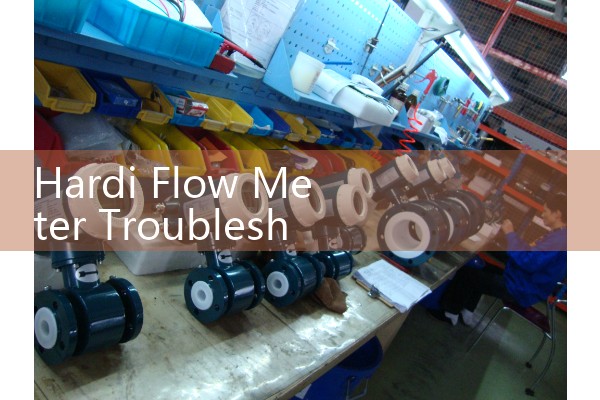
If the rotor is worn, the cable is cracked, and the connector is corroded, buying three spare parts may cost more than a new meter. A replacement flow meter from Silver Instruments can solve the variance without changing your entire sprayer console. The Silver Instruments SIL-MAG-DN10 electromagnetic flow meter works in DN10 to DN15 lines. It has no rotor, no bearings, and no moving parts. The meter outputs 4-20 mA plus a configurable pulse, so it connects to most Hardi controllers with a simple signal interface.
Specifications for the SIL-MAG-DN10 include 0.5 percent of reading accuracy, 316L electrodes, PTFE liner, 24 V DC supply, IP67 housing, and a process pressure rating of 10 bar. Liquid conductivity should be at least 20 µS/cm. Most liquid fertilizers and pesticide mixes are above this level. If your mix is oil based, choose a small oval gear flow meter instead.
A vineyard sprayer operator in Chile replaced a worn Hardi turbine meter with a Silver Instruments unit last season. His spray volume error dropped from 8 percent to under 1 percent. That is the kind of improvement we see when the signal becomes stable.
Here is the thing. The replacement is not only about accuracy. It is about repeatability. A sprayer controller can compensate for a small offset. It cannot compensate for a signal that jumps. An electromagnetic flow meter gives a smooth reading because it measures velocity directly across the full pipe.
If you want a quote, send us your liquid type, conductivity (µS/cm), pressure (bar), temperature (°C), pipe size (DN), and flow range (L/min). We will reply with a price, lead time, and wiring notes for Hardi consoles. Contact Silver Automation Instruments by Tel: +86-25-68650347, Whatsapp: +86-25-52155837, or WeChat: +86 15365082610.
FAQ
Why does my Hardi flow meter read high after the tank gets warm?
The liquid viscosity drops as temperature rises. Turbine and paddle wheel sensors spin faster in thinner liquid at the same actual volume. If the temperature change is more than 10 °C, recalibrate or switch to an electromagnetic flow meter that does not rely on rotor speed.
Can I use a Silver Instruments electromagnetic flow meter with a Hardi sprayer controller?
Yes. Most Hardi controllers accept a pulse input. The SIL-MAG-DN10 has a configurable pulse output and 4-20 mA. You can set the pulse per liter to match the controller K factor.
What is the minimum liquid conductivity for an electromagnetic flow meter on a sprayer?
The SIL-MAG-DN10 requires at least 20 µS/cm. Clean water with some liquid fertilizer usually measures 500 to 2000 µS/cm. Very pure water or oil based carrier fluids may fall below this limit.
How do I know if the flow meter or the pump is causing volume variance?
Install a pressure gauge between the pump and the flow meter. If pressure is stable and flow readings still jump, the flow meter signal is the problem. If pressure pulses, check the pump valves, accumulator, or suction line first.
What pipe size is common for Hardi sprayer flow meters?
Most small and medium sprayers use DN10 to DN25 lines. Flow ranges are often 5 to 200 L/min. Send us your DN size and flow range so we can recommend the correct meter body and process connection.